
Chobe vs Okavango Delta: Which Botswana Safari Should You Choose?
Quick Answer: Chobe vs Okavango Delta
Choose Chobe National Park for the highest concentration of elephants on Earth, spectacular boat-based river safaris, and easy accessibility (only 70 km from Victoria Falls). Choose the Okavango Delta for remote, fly-in wilderness exclusivity, traditional mokoro canoe excursions through seasonal floodplains, and unmatched luxury private concessions. Most luxury Botswana itineraries combine 2–3 nights in Chobe with 3–4 nights in the Delta.
Chobe vs Okavango Delta: Side-by-Side Comparison
| Key Feature | Chobe National Park | Okavango Delta |
|---|---|---|
| Primary Landscape | Chobe Riverfront, floodplains, teak forests & Savuti marsh | Labyrinth of permanent lagoons, channels & palm islands |
| Signature Wildlife | 120,000+ elephants, massive buffalo herds, riverfront predators | Leopards, red lechwe, wild dogs, sitatunga & rich birdlife |
| Primary Activities | Motorized boat safaris, open 4×4 game drives, photographic boats | Mokoro (dugout canoe), motorboat cruises, walking safaris & 4×4 drives |
| Accessibility | Drive-in via Kasane (BBK) or road transfer from Victoria Falls | Light aircraft fly-in only from Maun (MUB) or Kasane |
| Cost (pppn) | $450 – $1,800+ USD | $1,200 – $3,500+ USD |
Chobe vs Okavango Delta: The Direct Answer
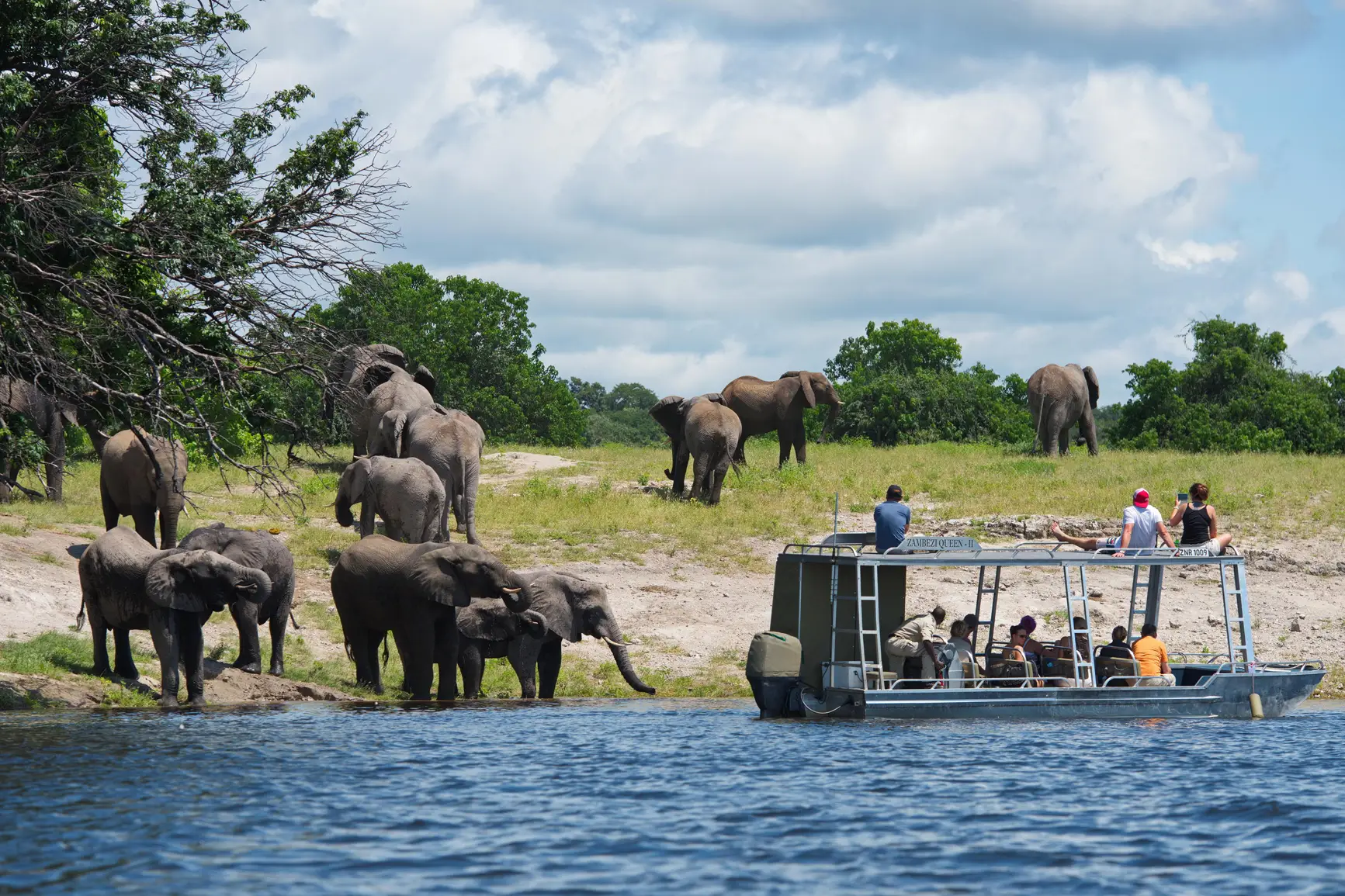
Choose Chobe National Park if you want the greatest elephant spectacle on Earth — herds of hundreds gathering on the Chobe River — combined with easy access from Victoria Falls and a broad price range of accommodation. Choose the Okavango Delta if you want Botswana’s most immersive and exclusive wilderness experience: mokoro canoes through papyrus channels, Africa’s best wild dog sightings, swimming lion, and a UNESCO World Heritage ecosystem where you may be the only vehicle for miles. Both are world-class; they deliver fundamentally different safari experiences.
Key Differences at a Glance
| Factor | Chobe National Park | Okavango Delta |
|---|---|---|
| Location | Kasane, northern Botswana | Maun, northwestern Botswana |
| Size | ~1.1 million hectares | ~15,000 km² (seasonal) |
| Signature experience | Elephant river spectacle, boat safaris | Mokoro canoe, water-based wildlife, wild dog |
| Elephant | World’s largest population — herds of hundreds | Large population — world’s highest total (~130,000 in Botswana) |
| Wild dog | Present in Savute; less reliable than Delta | Outstanding — one of Africa’s best |
| Lion | Excellent — follow elephant herds on floodplains | Excellent — some prides adapted to swimming |
| Leopard | Present; less reliably seen | Present in riverine forest |
| Water activities | Boat safari on Chobe River | Mokoro, motorboat, swimming safaris |
| Vehicle density | Moderate — national park; some crowding near Kasane | Very low — exclusive private concessions |
| Accessibility | Easy — Kasane airport; 80km from Victoria Falls | Fly-in only — charter from Maun (10–30 min) |
| Price range | Wide — budget camps to luxury lodges | High — Botswana’s most expensive destination |
| UNESCO status | No | Yes — World Heritage Site (2014) |
Chobe’s Unmatched Elephant Experience
Chobe National Park’s Chobe Riverfront is where Africa’s elephant story reaches its most dramatic expression. During the dry season (May–October), elephant from across northern Botswana converge on the Chobe River in herds of hundreds. A two-hour boat safari from Chobe Game Lodge or Chobe Chilwero can pass dozens of elephant herds drinking, bathing, swimming across the river, and calves nursing in the shallows — all from a distance of 10–30 metres. No other destination on Earth delivers elephant encounters at this scale and proximity.
The Okavango’s Wild Dog Advantage
The Okavango Delta ecosystem — including Moremi Game Reserve, the Kwedi Reserve, and private concessions like Chitabe and Vumbura Plains — holds one of Africa’s most significant African wild dog populations. Multiple resident packs with known denning sites are monitored across the system. For guests for whom wild dog is a priority species, the Okavango is unrivalled. Chobe’s Savute section has wild dog but sightings are less reliable.
The Water Safari Experience
The Okavango Delta’s mokoro experience — gliding silently through papyrus channels in a traditional dugout canoe, watching elephant on a nearby island and hippo surfacing 20 metres away — is an experience available nowhere else in Africa. It is the Delta’s most distinctive offering and one of the continent’s truly unique wildlife encounters. Chobe’s boat safaris on the Chobe River are excellent but operate as motorised vessels; the intimacy and silence of the Delta mokoro is different in character.
Which Is Better Value?
Chobe offers a significantly wider price range than the Okavango. Budget and mid-range accommodation exists around Kasane (outside the park) from approximately USD 200–400 per person per night. The Okavango Delta’s exclusive concession model means very few lodges under USD 700 per person per night, with most quality concessions ranging from USD 900–3,000+ per person. For guests with budget constraints, Chobe offers genuine Botswana wilderness at a lower entry price.
Can You Combine Chobe and the Okavango Delta?
Yes — and this is the classic Botswana safari circuit. The combination delivers the best of both ecosystems: Chobe’s elephant spectacle and Victoria Falls access, then the Okavango’s exclusivity, water activities, and wild dog. A standard circuit: 2 nights Victoria Falls + 2 nights Chobe Riverfront + 3 nights Okavango Delta. African Safari Group designs this combination as one of our most popular Botswana itineraries.
Frequently Asked Questions
Is Chobe or the Okavango closer to Victoria Falls?
Chobe — approximately 80 kilometres from Victoria Falls by road (1.5 hours including border crossing). The Okavango Delta is accessed from Maun, which is 800+ kilometres from Victoria Falls by road; most guests fly between the two.
Which has more wildlife diversity — Chobe or Okavango?
The Okavango Delta’s combination of aquatic and terrestrial habitats supports greater biodiversity overall — particularly for birds (550+ species) and specialist aquatic species like sitatunga and lechwe that are absent from Chobe. Chobe’s Savute and Linyanti zones add significant predator diversity beyond the Riverfront’s elephant focus.
Do you need a visa for Botswana?
Citizens of the US, UK, EU, Australia, New Zealand, and most Western countries enter Botswana visa-free for 30–90 days for tourism.
Plan Your Botswana Safari
African Safari Group designs Chobe and Okavango itineraries — independently or as combined Botswana circuits — often linked with Victoria Falls, Zimbabwe, or South Africa for a complete southern Africa journey.
Enquire Now to plan your Botswana safari.